We see it with virtually every B2B company: the marketing department invests heavily in SEO, advertising and content to drive traffic to the website. But once visitors land on the site, only a fraction convert. The average B2B website achieves less than 2% conversion.
With the right tactics, you can structurally generate more leads from your existing website traffic, without needing additional advertising budget. In this article, we share 10 proven methods that B2B organisations are successfully using in 2026 to generate more leads.
What exactly is a lead?
Before we discuss the tactics, it’s important to be clear about what we mean by a ‘lead’. A lead is a person or organisation from whom you’ve collected sufficient information to demonstrate interest in your product or service. This information could be an email address, telephone number or company name, but also behavioural data such as pages viewed, download behaviour or return frequency.
What precisely qualifies as a lead varies by organisation. And this regularly leads to discussions between marketing and sales. Marketing sees an email address as a lead, whilst sales only becomes interested once budget and decision-making authority have been established. These different definitions cause friction and missed opportunities.
That’s why we advise clearly aligning internally on what a Marketing Qualified Lead (MQL) and Sales Qualified Lead (SQL) mean for your organisation. What behaviour or characteristics must a lead demonstrate to be passed on to sales? By establishing these criteria, you prevent endless discussions and ensure efficient lead follow-up that actually results in deals.
How do I generate more leads?
The core of effective lead generation is simpler than many marketers think. It revolves around three pillars that reinforce each other. Firstly, you need to make it easier for visitors to make contact by lowering barriers and optimising conversion paths. Secondly, you need to offer value in exchange for contact details, so visitors have a reason to leave their information. And thirdly, you need to identify the companies that are already showing interest but haven’t yet filled in a form.
That last pillar is often forgotten, but is perhaps the most powerful. Because why would you only focus on the 2% who fill in a form, when you can also make the remaining 98% visible? By using website visitor identification, you discover which organisations are visiting your site, which pages they’re viewing and how often they return. This information enables sales to proactively contact warm prospects.
By combining these three pillars, you significantly increase your lead volume without additional advertising costs. You’re simply getting more return from the traffic you already have.
10 proven tactics for more B2B leads
1. Identify companies visiting your website
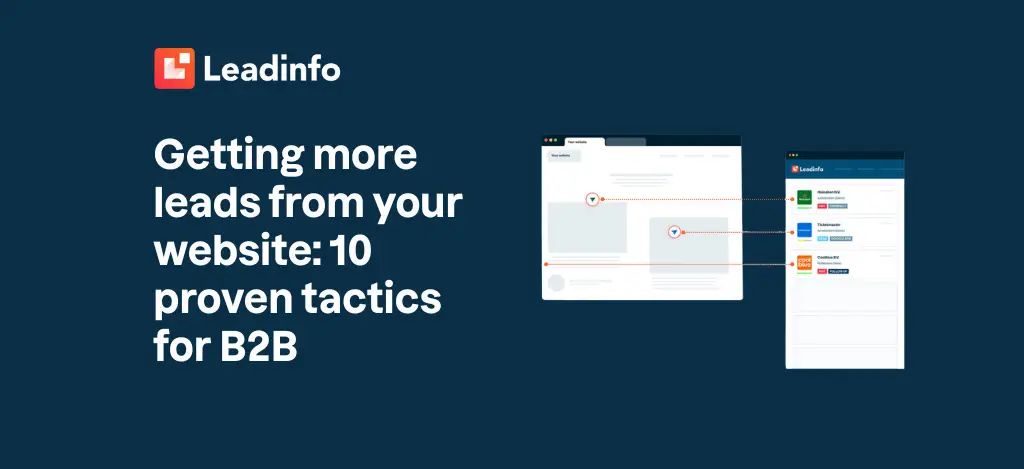
The fastest and most direct way to generate more leads is by discovering which companies are already visiting your website. It sounds almost too simple, but the impact is enormous. With website visitor identification software, the invisible becomes visible.
Imagine: an IT manager at a medium-sized company in London visits your website. He views your product pages, reads two case studies and spends five minutes on your pricing page. He then leaves your site without filling in a form. In the traditional model, that visitor is lost forever. With visitor identification, you know precisely which company it was, which pages were viewed and how long the session lasted.
This information is gold for your sales team. Instead of cold calling random companies, they can now contact organisations that have demonstrably shown interest. “We noticed you were looking at our integration capabilities. Do you have questions about connecting with your current systems?” That’s a completely different conversation than a standard sales pitch.
The beauty is that this works fully GDPR-compliant. The technology identifies companies based on network-level metadata and IP mapping, not individual people. No cookies are placed and no personal data is collected without consent.
With a tool like Leadinfo, you get significantly more from your existing traffic. Compare that with the 2% who on average fill in a form. Where you previously had 20 leads from 1,000 visitors, you now gain insight into 350-400 companies. That’s a completely new world of possibilities for your sales and marketing team.
2. Optimise your conversion paths in detail
A conversion path is the complete route a visitor takes to ultimately perform a desired action. This could be downloading a whitepaper, requesting a demo or filling in a contact form. Without clear and optimised conversion paths, you simply won’t generate leads, no matter how much traffic you send to your website.
We regularly see websites where millions have been invested in design and content, but where the conversion paths underperform. A beautiful product page without a clear call-to-action. An interesting blog article that leads nowhere. A contact form with fifteen mandatory fields that nobody wants to complete. The result is predictable: visitors drop off.
An effective conversion path consists of four essential elements that seamlessly connect. Firstly, there are call-to-actions (CTAs) that grab attention and entice visitors to take the next step. These CTAs lead to landing pages with a crystal-clear value proposition, where visitors understand precisely what they’re getting and why it’s valuable. On these pages are forms that don’t intimidate through length or complexity. And finally, there are thank-you pages that strengthen the relationship and stimulate further action.
Each of these elements deserves attention. Take CTAs: they must be action-oriented (“Download now” instead of “More information”), visually stand out without being garish, and suit the stage the visitor is at. A visitor reading your blog for the first time isn’t ready for a demo request. They want to learn more first via an e-book or checklist.
Landing pages must be focused on one goal. Remove all navigation that distracts. Clearly describe what the visitor gets and why it’s worth their time. Use bullet points for scannability and add a relevant visual element that underscores the value.
Forms are often where conversions fail. We see it time and again: the more fields, the lower the conversion. Only ask for what you really need at this stage of the relationship. An email address is often sufficient for a first contact moment. Later, when the lead becomes warmer, you can collect additional information.
Analyse where visitors drop off in your conversion paths. Use Google Analytics to see which steps lose the most traffic. Often the solution lies in smaller adjustments: clearer button text, a shorter form or faster loading time. These details make the difference between a conversion rate of 1% and 5%.
3. Use lead scoring for smart prioritisation
Not every lead is equally valuable, and not every lead deserves the same attention from your sales team. A marketing manager at an enterprise organisation who visits your pricing page three times is a completely different prospect than a student reading your blog for coursework. By using lead scoring, you automatically bring structure to your lead flow.
Lead scoring works by assigning points to specific behaviour and characteristics. Behavioural scores reflect what a lead does: which pages do they view, how often do they return, what content do they download, how long do they stay on the site? A visit to the pricing page yields 15 points, for example, whilst a blog visit is worth 5 points. A demo request scores 50 points, a newsletter subscription 10.
Additionally, there are profile scores that reflect who the lead is. Does the company fit within your ideal customer profile? Is the contact person a decision-maker or influencer? How large is the organisation? In which industry does the company operate? A marketing director at a SaaS company with 200 employees scores higher than a junior marketer at a startup with 5 people.
By combining these scores, a clear picture of lead quality emerges. Leads with high scores come to the top of sales’ priority list. Leads with low scores go to nurture campaigns to warm them up further. Leads that don’t fit within your ICP are disqualified.
The result is that your sales team spends their time on the most promising opportunities instead of randomly calling through a list. This not only increases conversion from lead to customer, but also improves your salespeople’s work experience. Nobody enjoys having dead-end conversations all day.
Tools like Leadinfo combine website behaviour with company information to automatically identify the most promising leads. You see not only which company visited your site, but also how large it is, in which industry it operates and whether it fits within your ideal customer profile. This combination of behaviour and profile is what makes lead scoring truly powerful.
4. Create valuable lead magnets that truly convert
Visitors only leave their contact details if they get something valuable in return. This exchange rate must be balanced: the value you offer must outweigh the effort of filling in a form and sharing personal information. A generic e-book that can be found everywhere on the internet won’t convince anyone. A unique checklist that solves a concrete problem will.
We see a clear hierarchy in what works as a lead magnet. At the top are practical tools that are immediately applicable: templates, calculators, checklists and assessments. These formats score highly because they deliver immediate value. An ROI calculator that allows a prospect to calculate their potential savings converts better than a theoretical whitepaper about cost reduction.
Below that come educational formats: e-books, whitepapers, reports and webinars. These work well when they provide in-depth expertise that can’t be found elsewhere. Your own research data, benchmarks from your customer base or detailed how-to guides fall into this category.
The key to effective lead magnets is specificity. “10 questions for your next CRM selection” converts better than “The complete guide to digital transformation”. The more concretely you address a specific problem of your target audience, the higher the conversion.
Place lead magnets strategically on pages where visitors are already showing interest in the relevant topic. A whitepaper about lead generation fits perfectly on a blog page about the same theme. A checklist for CRM implementation belongs on your integration pages. This contextuality ensures the offer feels relevant, not pushy.
Don’t forget to update lead magnets either. An e-book from 2022 feels dated, even if the content is still relevant. By regularly updating, you maintain attractiveness and show that your expertise is current.
5. Integrate with your CRM for seamless and direct follow-up
A lead you generate is worthless if it doesn’t end up in your sales process. Sounds logical, but we regularly see this go wrong. Marketing teams collect leads in spreadsheets or separate tools, only to then manually transfer them to sales. This process is error-prone, time-consuming and inevitably leads to missed opportunities.
The solution is seamless integration between your lead generation tools and your CRM system. When a company visits your website and meets certain criteria, a lead or deal is automatically created in your CRM with all relevant information. Your sales team immediately sees which pages were viewed, how often the company returned and what content was downloaded. This context makes the first conversation many times more effective.
Popular CRM integrations include HubSpot, Salesforce and Pipedrive. With more than 70 integrations, Leadinfo connects to virtually any system you use.
The power lies in setting up smart triggers. Not every website visitor deserves a place in your CRM. But a company that views three or more pages, visits the pricing page and fits within your ideal customer profile? They automatically belong as a lead in your system, including a notification to the account manager.
You can go a step further by automating tasks and reminders. A new high-intent lead automatically triggers a task for follow-up within 24 hours. A returning visitor gets a follow-up action for the account owner. By setting up these workflows, no opportunities slip through the net.
6. Use intent data to strike at the perfect moment
Timing is everything in sales. Contacting a prospect who is actively researching yields a completely different conversation than cold calling someone who isn’t thinking about anything. Intent data enables you to identify that perfect moment and act on it.
First-party intent data comes from your own website and is therefore the most reliable source. You see which pages a company views, how often they return, how long they stay and what content they consume. These signals tell a story about where an organisation is in the purchasing process.
A company visiting your homepage for the first time and leaving after thirty seconds is barely a signal. But a company that returns weekly, delves ever deeper into your product pages, reads three case studies and spends ten minutes on your pricing page? That’s an organisation actively evaluating and ready for contact.
By monitoring intent data, you can determine the right moment to make contact. Not too early, when the prospect is still in the orientation phase and feels pushed. Not too late, when the decision has already been made and your competitor has won the deal. But precisely at the moment the prospect is open to a conversation.
You can also use intent data to personalise your message. If you know a prospect is mainly interested in your integration capabilities, you don’t open with a generic sales pitch but with specific information about connecting with their CRM. This relevance significantly increases the chance of a positive response.
7. Implement retargeting at company level for lasting visibility
The buyer journey in B2B is rarely linear. Prospects visit your website, disappear for weeks, come back, research competitors and eventually make a decision. This entire journey can take months. If you disappear from view after the first visit, you miss the majority of that journey.
Retargeting keeps you top-of-mind with visitors who showed interest but haven’t yet taken action. By connecting data from Leadinfo to advertising platforms such as LinkedIn Ads or Google Ads, you can specifically target the companies that visited your site. You show relevant advertisements to employees of organisations that have already shown interest. That’s many times more efficient than broad campaigns to your entire target audience.
The content of your retargeting campaigns must match the stage of the buyer journey. Visitors who only saw your homepage get awareness content: an interesting article or thought leadership video. Visitors who viewed your pricing page get decision content: a case study, demo invitation or limited-time offer. This segmentation ensures relevance and prevents irritation.
8. Optimise your website for mobile visitors
The B2B buyer of 2026 doesn’t start their research behind a desktop in the office. More than 60% of B2B research starts on a mobile device. On the train, between meetings, in the evening on the sofa. If your mobile experience is substandard, you lose leads before they can even convert.
We see it regularly: B2B websites that look fantastic on desktop but are a disaster on mobile. Text that’s too small to read. Buttons that are too close together to click. Forms that are impossible to fill in on a small screen. Loading times of ten seconds or more. Every friction point is a reason for the visitor to drop off.
The impact is measurable. Research shows that every second of delay in loading time results in 7% fewer conversions. A page that loads in five seconds instead of two therefore loses over 20% of its potential conversions. Those are leads you’ll never see.
Start with a thorough audit of your mobile experience. Test your site with Google’s Mobile-Friendly Test and PageSpeed Insights. Go through the entire conversion path yourself on your phone. Can you navigate easily? Are texts readable? Can forms be filled in? Do all interactive elements work?
Pay specific attention to these elements: loading speed (optimise images, minimise scripts, use caching), touch-friendliness (sufficient space between clickable elements), readability (minimum 16px fonts, sufficient contrast) and form optimisation (larger input fields, fewer fields, smart keyboards).
An optimised mobile experience is not a luxury but a necessity. It’s often the first point of contact with potential customers. That first impression determines whether they continue or drop off.
9. Deploy chatbots strategically as a conversion accelerator
A well-positioned chatbot isn’t an irritating pop-up but a helpful assistant that supports visitors at the moment they need it. The difference lies in the strategy: not pushing, but facilitating.
Visitors to your website often have questions that prevent them from converting. “Does this work with our CRM?” “What are the costs for our size of company?” “How quickly can we go live?” Answering these questions takes time if they have to go via email or telephone. A chatbot provides instant answers, 24/7.
The power of a chatbot also lies in lead qualification. By asking the right questions, you quickly identify whether a visitor fits within your ideal customer profile. How many employees does your company have? What challenge do you want to solve? How quickly do you want to get started? Based on the answers, you route warm prospects directly to sales for a personal conversation, whilst less qualified visitors are directed to self-service content.
Timing and placement are crucial. A chatbot that pops up immediately when you load the page irritates. The same bot appearing after someone has been looking at the pricing page for 30 seconds offers help at precisely the right moment. Experiment with triggers: time on page, scroll depth, exit intent, specific pages.
The results can be impressive. Leadbot generates up to 300% more conversions than traditional contact forms. This is because the barrier is lower. A chat conversation feels more informal and accessible than filling in a form. And the direct interaction creates engagement that forms lack.
Do ensure your chatbot is valuable though. Nothing is more frustrating than a bot that doesn’t understand your question and sends you through endless menus. Invest in good flows, train your bot with frequently asked questions and ensure a smooth handover to human colleagues when the bot can’t help.
10. Measure, analyse and optimise in a continuous process
Lead generation isn’t a project with an end date but an ongoing process of improvement. The tactic that works today may be outdated tomorrow. Competitors copy your approach, visitor behaviour changes, technology evolves. Only by continuously measuring, analysing and optimising do you stay ahead.
Start by establishing your baseline. How many visitors does your website attract? What is your current conversion rate? How many leads do you generate per month? What is the quality of those leads, measured in conversion to customer? Without these figures, you cannot measure improvement.
Then formulate hypotheses. “We expect a shorter form to increase conversion by 20%.” “We think a more prominent CTA on the product page will generate more demo requests.” “We believe a more personal chatbot greeting will improve the conversation rate.” By formulating hypotheses, you make your assumptions explicit and testable.
Test one variable at a time. If you simultaneously change the button text, colour and position, you won’t know which change caused the effect. A/B tests compare two variants on one element. This way, you build knowledge step by step about what works for your target audience.
Dare to fail too. Not every test yields a positive result. A button text change that reduces conversion by 5% is also valuable: you now know what doesn’t work. This knowledge prevents you from making the same mistake on other pages.
Make optimisation part of your routine. Reserve time weekly for data analysis. Plan new tests monthly. Evaluate your complete lead generation strategy quarterly. By maintaining this cadence, you keep moving forward instead of standing still.
I want to generate more leads quickly. How should I approach this?
For organisations that want to see quick results, we recommend focusing on three quick wins that can be implemented within a week and deliver immediately measurable results.
The first step is installing a website visitor identification tool like Leadinfo. Within a day, you’ll see which companies are visiting your website, which pages they’re viewing and how often they return. This information immediately delivers a list of warm prospects that sales can work with. No weeks of preparation, but results the same day.
The second step is adding a lead magnet to your most visited pages. Look in your analytics at which pages attract the most traffic and add a relevant download there in exchange for an email address. A checklist, template or mini-guide that you can create in a day. The more specific the match with the page content, the higher the conversion.
The third step is shortening your forms to a maximum of three to four fields. Remove every field that isn’t strictly necessary for initial follow-up. Telephone number, company size, job title: you can collect this information later. Right now, it’s about making the barrier as low as possible.
These three actions require no major investments or lengthy implementation processes. They’re operational within a week and deliver immediately measurable results.
Frequently asked questions
How do I generate more leads via my website?
Generating more leads via your website is achieved by combining three elements. Firstly, identify the companies visiting your site with visitor identification software, so you’re no longer dependent on the 2% who fill in a form. Then optimise your conversion paths with clear CTAs, compelling landing pages and short forms that don’t intimidate. And finally, offer valuable content such as e-books, checklists or templates in exchange for contact details. By combining these three pillars, you structurally generate more leads from your existing traffic without additional advertising costs.
Is website visitor identification GDPR-compliant?
Yes, website visitor identification is fully GDPR-compliant, provided you use the right tools and properly set up your own cookie policies. Leadinfo identifies exclusively companies, not individuals, and can be used completely cookieless. The legal basis is Article 6(1)(f) GDPR: legitimate interest for B2B marketing. All data is hosted in EU data centres, and no transfer takes place to countries outside the EU. Leadinfo is also ISO 27001:2022 certified.
How many leads can I expect from website visitor identification?
Leadinfo is the B2B lead generation tool with the highest coverage rate. With an identification rate of 35-40%, you can identify a substantial portion of your B2B traffic at company level. With 1,000 monthly visitors, this means 350-400 identified companies with information about which pages they viewed, how long they stayed and how often they returned. Compare that with the average 2% form conversion, which yields only 20 leads. The exact numbers depend on your traffic volume, the composition of your visitors and your industry.