
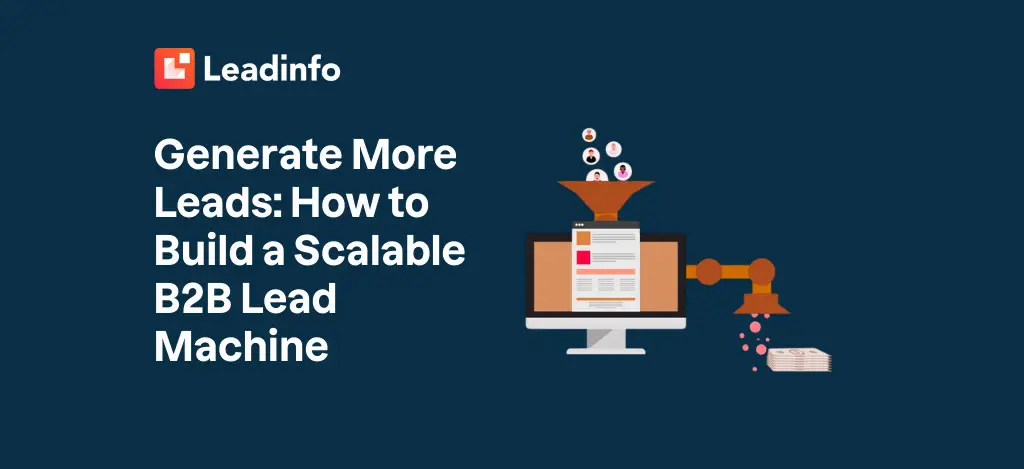
Most B2B websites convert less than 2% of their visitors. That means 98% of your website traffic remains unidentified and leaves your funnel without ever making contact. The good news: with the right approach, you can transform this unknown business traffic into a predictable stream of qualified leads.
In this article, you’ll learn step by step how to build a scalable B2B lead machine.
Step 1: Identify Which Companies Are Visiting Your Website
This is the most impactful step that most B2B companies skip entirely. You invest in SEO, advertising and content to drive traffic to your website. But what happens to those visitors who don’t immediately fill in a form?
The answer: they disappear. Unless you identify them.
How Website Visitor Identification Works
With a tool like Leadinfo, you can see which companies are visiting your website before they even make contact. You gain insight into:
- Which company is visiting your site (company name, sector, size)
- Which pages they’re viewing (product, pricing, case studies)
- How often they return
- What buying intent they’re showing
Why This Should Be Your Primary Lead Generation Channel
The average identification rate sits between 35 and 40 percent. That means for every 1,000 visitors, you potentially receive 350 to 400 company names. These are warm leads: they’ve actively shown interest by visiting your website.
Compare that to cold outreach or purchased lists. Companies visiting your site are already in a research phase. They know your brand and are actively investigating a solution.
With Leadinfo, you can send these identified companies directly to your CRM via more than 70 integrations, including HubSpot, Salesforce and Pipedrive. Sales receives instant alerts via Slack or their CRM when an ICP match views the pricing page. Marketing can set up retargeting campaigns for ICP leads. All 100% GDPR-compliant.
Step 2: Set Measurable Goals and KPIs
Before you choose channels, you need to know what you’re working towards. Formulate SMART objectives:
Example: “In Q2 2025, we’ll generate 150 qualified leads via our website—a 40% increase compared to Q1.”
Then determine your KPIs:
- Number of identified companies per month
- Conversion rate from visitor to lead
- Cost per lead (CPL)
- Lead-to-opportunity ratio
Start by working backwards. How many leads do you need for one customer? If you need an average of 10 leads per deal and you want 5 new customers per month, you need 50 qualified leads monthly.
Step 3: Optimise Your Website for Conversion
You can generate as much traffic as you like; if your website doesn’t convert, your funnel leaks. Many B2B websites are too static, too corporate, and make it unnecessarily difficult for visitors to take action.
Call-to-Actions That Work
Ensure a clear action is possible on every page. Place your most important CTA within thumb reach on mobile. Make phone numbers clickable. Keep your contact form short: only ask for what you genuinely need.
Don’t Forget the ‘About Us’ Page
This is one of the most visited pages on any website. Visitors want to know who they’re doing business with. Show faces, tell your story and make it personal. Anyone landing here is interested. Close with a clear CTA.
Improve Session Duration
In B2B, the decision-making process takes longer. The longer someone stays on your site, the greater the chance you’ll remain top-of-mind. Aim for an average session duration of at least 2 minutes. Offer valuable content, clear navigation and fast loading times.
Step 4: Deploy Content Marketing Strategically
Content is the fuel for your lead machine. With the right content at the right moment, you increase your organic visibility whilst building trust with potential customers.
What Content Works for B2B?
Combine different content formats:
- How-to guides that solve concrete problems
- Case studies that prove results
- Comparison articles for solution-aware visitors
- FAQs for AEO (Answer Engine Optimisation)
- Webinars and videos for deeper engagement
According to HubSpot research, companies that publish 16 or more blogs per month generate 4.5 times more leads than companies publishing 0 to 4 articles.
Content for Every Stage of the Buyer Journey
- Awareness: Educational content about the problem
- Consideration: Comparisons and solution-focused content
- Decision: Case studies, demos and product information
Step 5: Activate the Right Channels
Now your foundation is in place, choose the channels that best suit your target audience and resources.
Email Marketing and Automation
Email remains one of the most effective B2B channels. With marketing automation, you send personalised messages based on behaviour. A visitor viewing your pricing page receives different content than someone who only reads your blog.
Lead nurturing is essential in B2B. Not every lead is immediately ready to buy. Feed them valuable content until they are. This requires consistency and relevance.
LinkedIn for B2B
LinkedIn is the most effective social platform for B2B lead generation. But not by broadcasting. Start conversations. Share knowledge. Help your target audience.
Most B2B companies use LinkedIn incorrectly: they only push their own content without adding value. The winners build relationships and position themselves as experts.
SEO and Organic Traffic
Organic growth takes time but delivers the most sustainable results. Focus on:
- Keyword research targeting buyer intent
- Content that’s better and more comprehensive than the competition
- Technical optimisation for speed and mobile
- Internal linking to distribute authority
Combine SEO with website visitor identification. That way, you see precisely which companies arrive via organic traffic and which search terms convert to qualified leads.
Step 6: Analyse, Test and Optimise Continuously
A successful lead machine is never finished. Test channels, tactics and messages. What works for one audience doesn’t automatically work for another.
Analyse not just quantity, but quality. 100 low-quality leads are worth less than 20 qualified leads that convert to customers.
Frequently Asked Questions About Lead Generation
How do I generate more leads?
You generate more leads by gaining insight into your website visitors, optimising your conversion and offering targeted content. Start by identifying which companies are visiting your website using a tool like Leadinfo. Then optimise your call-to-actions, shorten your contact forms and ensure relevant content for every stage of the buyer journey. Combine this with email marketing, LinkedIn and SEO for a complete lead generation process.
How do I set up a successful online lead generation campaign?
A successful lead generation campaign starts with a clear target audience, a valuable offer and measurable goals. First, define your ideal customer profile (ICP). Then create content that solves a specific problem, such as a whitepaper or webinar. Promote this via the channels where your target audience is active. Measure results with tools that identify website visitors, so you capture not just form submissions but also previously invisible traffic. Optimise continuously based on data.
I want to generate more leads quickly. Give me concrete advice on how to approach this.
For fast results, focus on three actions: identify your existing website traffic, optimise your key landing pages and activate your warmest prospects. Install a website visitor identification tool today to immediately see which companies are visiting your site. Check your pricing and product pages for clear CTAs. Export identified ICP matches to your CRM and have sales make contact within 24 hours. These three steps often deliver additional leads within a week.
Which channels are most effective for generating more leads?
The most effective B2B lead generation channels are: website visitor identification, email marketing, LinkedIn and SEO. Website visitor identification is the most underutilised channel with immediate results: you see which companies are already showing interest. Email scores highest on ROI through personalisation and automation. LinkedIn is the most powerful social platform for B2B. SEO delivers the most sustainable long-term results. The art lies in combining these channels into an integrated strategy.
Start Building Your Lead Machine Today
A scalable B2B lead machine revolves around three pillars: visibility, relevance and action. You now know which companies are visiting your website. You’re offering the right content at the right moment. And you’re making it easy to take the next step.
Start at the beginning: identify your website visitors. This is the fastest way to monetise your existing traffic. Combine this with conversion optimisation, content marketing and the right channels.
Want to see which companies visited your website today? Start your free trial and begin building your lead machine immediately.