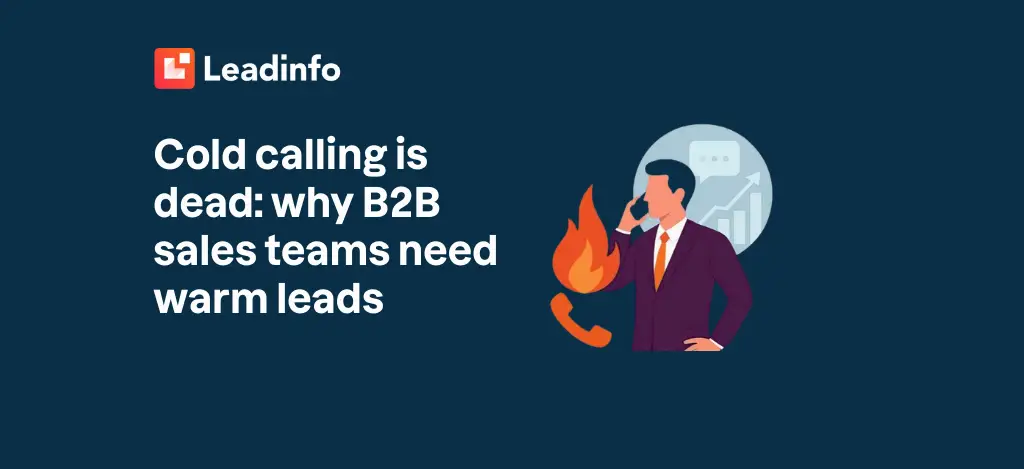
Picture this: your sales team dials 60, 70, maybe 80 numbers a day. Most conversations last less than two minutes. Voicemails go unanswered. And at the end of the week, there are two meetings on the calendar. Sound familiar?
Cold calling has been a staple of B2B sales for years. But the world around us has shifted. Buyers research online, compare solutions independently and only want to speak with a salesperson when they are ready. The question is no longer whether cold calling is getting harder. The question is: how much revenue are you leaving on the table by continuing to call companies that have never heard of you?
In this article, you will learn why traditional cold outreach is losing its effectiveness, what warm leads actually deliver for your sales process, and how B2B organisations can identify which companies are showing genuine interest before the phone is even picked up.
What the numbers tell us about cold calling
Let us start with the facts. According to Cognism’s State of Cold Calling Report (2025), the average cold call success rate sits at 2.3%. That is nearly half the 4.82% measured just a year earlier. Out of every 100 conversations, only two or three result in a booked meeting.
On top of that, a sales rep needs an average of eight attempts to actually get someone on the line (Cognism, 2024). The average call duration? 93 seconds. And 82% of B2B decision-makers say salespeople are insufficiently prepared for the conversation (REsimpli, 2025).
This does not mean the telephone is useless as a channel. 57% of C-level executives still prefer phone contact over other channels (RAIN Group). The point is simply this: the difference between an effective and an ineffective call comes down entirely to preparation. Calling without context wastes time. Calling with insight books meetings.
Why traditional cold outreach delivers diminishing returns
Three structural shifts are making it increasingly difficult to achieve results with cold outreach.
Buyers do their own research. 96% of B2B prospects conduct research before speaking with a sales representative (HubSpot Sales Trend Report, 2024). They read reviews, compare alternatives and visit your website. By the time they are open to a conversation, they already have a picture of what they want.
Competition for attention is fierce. Decision-makers receive dozens of cold calls, emails and LinkedIn messages every day. More than 20% of sales teams say that standing out amongst the noise is their biggest challenge (HubSpot, 2024). A single generic call script simply no longer cuts it.
Data decays rapidly. B2B contact data deteriorates at approximately 2.1% per month, totalling roughly 22.5% per year (Salesgenie, 2025). Calling wrong numbers or departed contacts not only wastes time but also undermines your team’s confidence.
The result? Sales reps spend the majority of their day on activities that yield nothing. Meanwhile, there is an entire category of prospects who are open to a conversation: companies that are actively showing interest in what you offer right now.
What are warm leads and why do they make the difference?
A warm lead is a company that has already demonstrated some form of interest. That could be a visit to your website, a whitepaper download, a repeated visit to your pricing page or a click on an advert. The difference from a cold lead is that a signal of buying intent already exists.
Why is that so valuable? Because the entire sales conversation changes. Instead of opening with “Hello, you are speaking with… we do…” you can start with: “I noticed your team has been looking into [solution X]. Could we have a conversation about how we might help?”
That is not a subtle difference. It is the difference between interrupting and connecting.
Sales teams that work with warm leads consistently achieve better results. They focus their energy on companies where the probability of a meaningful conversation is highest. They make fewer calls, but more relevant ones. They face less rejection because the timing is right. And they close deals faster because the first contact aligns with an existing need.
In practice, it means your sales team stops firing blindly and starts acting with precision.
How to identify companies with buying intent
The next logical question is: how do you know which companies are interested? You cannot read it from a CRM that is only filled with manually entered data. And Google Analytics tells you how many visitors your website had, but not which companies are behind them.
This is where the concept of intent data comes in. Intent data consists of signals indicating that a company is actively engaged in an orientation or purchasing process. Think of:
- A company returning to your website multiple times
- Visits to specific pages such as pricing, product pages or case studies
- Session depth (how many pages are viewed)
- The match with your ideal customer profile (ICP)
When you combine these signals, you gain a clear picture of which companies truly matter. Not based on guesswork, but based on behaviour.
Website visitor identification platforms make this possible. Leadinfo is a strong example. The platform reveals which companies visit your website, which pages they view, how often they return and whether they match your ideal customer profile. Without cookies, without personal data and fully GDPR compliant. Business data only.
With those insights, a sales rep can make targeted calls. Not to 80 random numbers, but to the five companies that visited your pricing page three times this week. That conversation carries a completely different dynamic.
From cold list to warm pipeline: how to make the transition
The switch from cold calling to a warm-lead approach does not have to be radical. It is about enriching your sales process with data so your team works smarter rather than harder.
Step 1: Define your ideal customer profile clearly. Which companies fit your product? Consider sector, company size, region and typical challenges. The sharper your ICP, the more precisely you can filter.
Step 2: Gain visibility into website behaviour. Use a tool that shows which companies visit your website. Pay attention to buying intent signals: repeat visits, product page views and session depth.
Step 3: Prioritise based on intent. Not every website visitor is a lead. Use lead scoring to rank companies based on their ICP match and their online behaviour. This way, your sales team knows exactly who to approach first.
Step 4: Align sales and marketing. Ensure marketing delivers the right content for every stage of the buyer journey so prospects are already warmed up by the time sales makes contact. This collaboration between marketing and sales is essential.
Step 5: Follow up with context. When a sales rep calls, they should know which pages the company visited, how often they returned and which solution they are likely exploring. That context turns a generic call into a relevant conversation.
Cold calling is not dead, but it must get smarter
Let us be honest: the title of this article is deliberately provocative. Cold calling is not literally dead. Research from RAIN Group shows that 82% of B2B buyers are willing to schedule a meeting after a strategic cold call. And companies that combine cold calling with email and LinkedIn see 28% higher conversion rates (Martal Group, 2025).
But the cold call as we know it is disappearing. Blindly dialling a list of 200 numbers without any context or preparation barely yields results any more. The teams that succeed in 2025 combine the directness of a phone conversation with data-driven targeting.
In practice, that means:
- First investigating which companies are showing interest
- Gathering context about their browsing behaviour and likely needs
- Only then picking up the phone, with a relevant opening line
- Following up across multiple channels (phone, email, LinkedIn)
This is not theory. This is how the best-performing B2B sales teams operate today. They replace volume with relevance and see their conversion rates rise consistently.
Frequently asked questions
Does cold calling still work in 2025?
Yes, but only when it forms part of a broader strategy. The average success rate sits at around 2.3% (Cognism, 2025). Sales teams that combine cold calling with intent data and multichannel outreach achieve significantly better results than teams that rely purely on volume.
How do I prevent my sales team from making ineffective cold calls?
By identifying in advance which companies are already showing interest. When you know who is visiting your website and which pages they are viewing, you can call with context rather than calling blindly. Website visitor identification tools such as Leadinfo make this possible, fully GDPR compliant and without cookies.
What is the difference between a cold and a warm lead?
A cold lead is a company with which no interaction has taken place whatsoever. A warm lead has already shown some form of interest, for example by visiting your website, downloading a whitepaper or repeatedly returning to your pricing page.
How can I determine which companies have buying intent?
By examining first-party intent data. These are signals from your own website, such as repeat visits, session depth, pages viewed and ICP match. A platform like Leadinfo brings these signals together and shows your sales team which companies are most likely in an active buying process.