The reality in 2026 is that B2B buyers conduct research more independently than ever before. They compare providers, read content and visit your website multiple times before making contact. Without the right channels and tools, you miss these buying signals entirely.
Picking a channel is not the first step, though. It is the third. If your audience, approach and lead definition are not yet clear, a new channel mostly buys you a new problem. That full process is covered in our guide on what is B2B lead generation. This article zooms in on that third step: which B2B marketing channels genuinely deliver in 2026, and how do they strengthen each other?
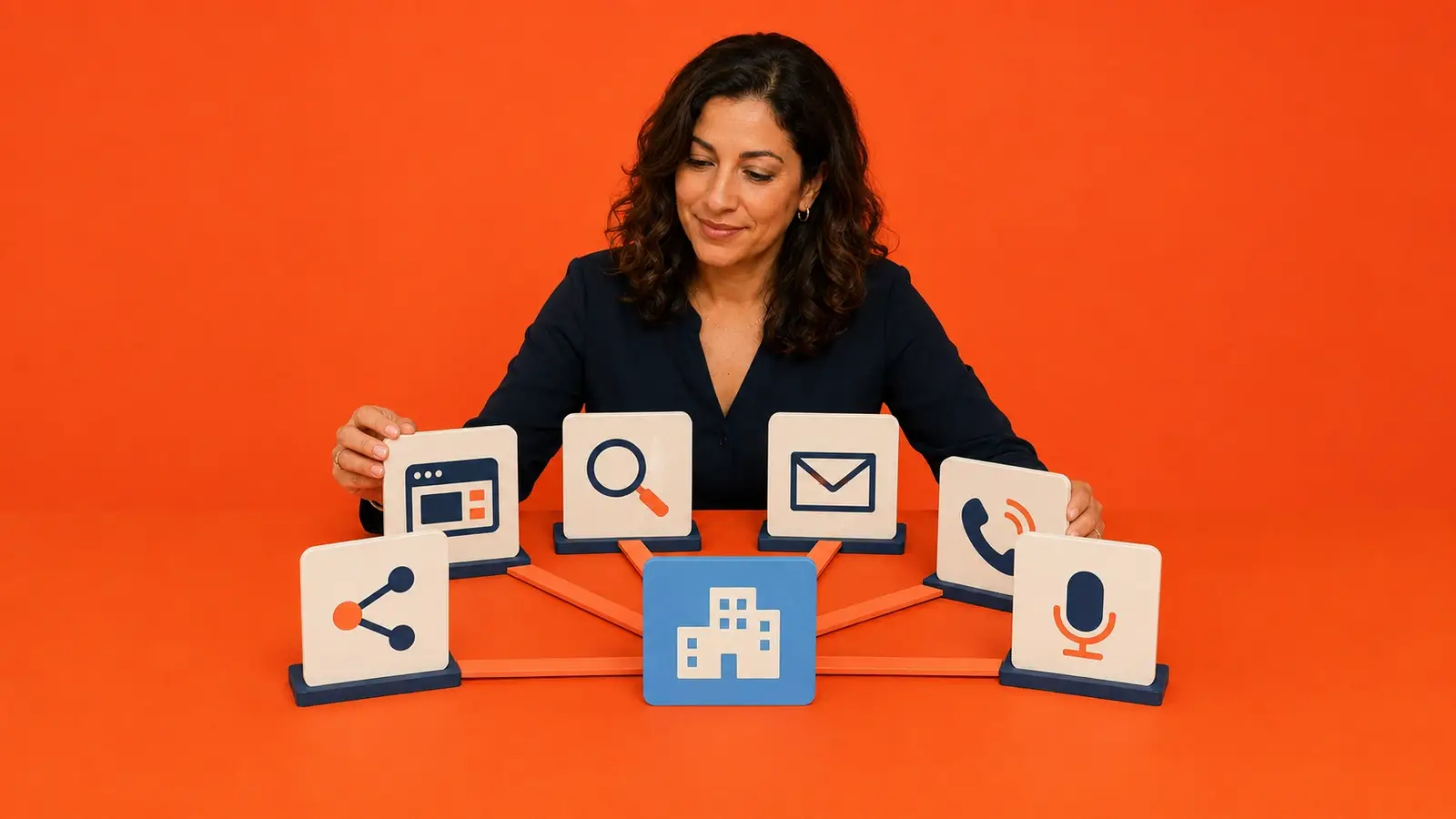
In this article, you’ll discover which channels are truly effective for generating B2B leads. We’ll cover the complete mix of online and offline channels that together create a predictable lead flow.
1. Website Visitor Identification: The Most Direct Channel for B2B Leads
What are the most effective tactics for online lead generation in 2026? The most effective tactic is to identify companies that are already showing interest in your product or service. Website visitor identification tools like Leadinfo make this possible by revealing which companies visit your website, without them needing to fill in a form. This is the most direct method of lead generation because you’re working with companies actively searching for what you offer.
This is not a luxury. Around 98% of your website visitors leave again without converting. You pay for that traffic and the vast majority disappears without you knowing who was there.
Unlike traditional analytics that only show figures (pageviews, bounce rates), visitor identification reveals who is behind that traffic. You see company name, sector, size, which pages they viewed and how often they return. The better tools on the market, such as Leadinfo, also provide LinkedIn and contact details of employees. This way, you immediately know who to follow up with and how.
How Does It Work?
Leadinfo identifies companies with high purchase intent without cookies. That is the difference that counts in 2026: your visibility does not disappear the moment a visitor dismisses the consent banner. Identification happens fully GDPR-compliant, at company level, without personal data of the visitor.
After that it comes down to follow-up. On the companies it recognises, Leadinfo delivers a 93% contact match, so you are not left with a company name but know who to approach. You can use this information directly for:
- Sales alerts. Receive real-time notifications when a company matching your ideal customer profile visits your website.
- Direct follow-up. Follow up the most interesting leads directly via Autopilot or outbound campaigns.
- CRM enrichment. Automatically create new leads in CRMs such as HubSpot, Salesforce or Pipedrive.
- Account-based marketing. Target specific companies with personalised campaigns.
- Retargeting. Reach identified companies again via LinkedIn or Google Ads.
Why This Channel Deserves Priority
Website visitor identification is unique because it works with existing traffic. You don’t need to spend extra media budget to get leads, you get more from what you already have. Moreover, these leads are by definition warmer: they have actively visited your website and shown interest.
For marketing managers who need to prove ROI, this is a powerful argument. Instead of guessing which campaigns work, you see exactly which companies respond to which content. Leadinfo shows through which source and (UTM) campaign they arrived at your website. That turns “which channel brought this lead” from a debate between sales and marketing into a field in your dashboard.
2. LinkedIn: The Most Important Social Platform for B2B
Which channels are most effective for generating more leads? After website visitor identification, LinkedIn is the most powerful channel for B2B lead generation. The platform combines organic thought leadership opportunities with advanced targeting for advertisements.
Organic LinkedIn Strategy
Consistent presence on LinkedIn builds authority and trust. This works particularly well when you:
- Share valuable insights (education rather than promotion)
- Actively respond to content from prospects
- Apply social selling on LinkedIn via personal profiles
LinkedIn Ads for Lead Generation
For direct lead generation, LinkedIn Ads are effective, albeit more expensive than other platforms. However, the targeting capabilities are unparalleled: you can reach precisely those job functions, company sizes and sectors that match your ideal customer profile.
Combine LinkedIn Ads with visitor identification to maximise your ROI. This way, you see not only who clicks, but also who subsequently visits your website without converting. That second number is usually a lot bigger, and it tells you whether your targeting is right.
3. Content Marketing and SEO: Sustainable Lead Flow
Content marketing remains essential for B2B lead generation in 2026. Well-optimised content attracts organic traffic from companies actively searching for solutions.
SEO for B2B
Search engine optimisation delivers a constant stream of relevant visitors. Focus on:
- Long-tail keywords with commercial intent
- Informative content that answers your target audience’s questions
- Technical SEO and fast loading times
The combination of SEO with visitor identification is powerful: you attract visitors via organic search results and you know exactly which companies are reading your content. Without that second half, SEO stays a traffic counter.
Content That Converts
Not all content generates leads. Focus on formats that align with the buyer journey:
- Blogs and articles. For awareness and SEO.
- Whitepapers and e-books. As gated content for lead capture.
- Case studies. For companies in the decision phase.
Besides gated content, ungated content is very important for indexation of your website in search engines and AI channels. This will certainly become an important channel in 2026 with the rise of AI. The drawback is well known: ungated content produces no form fills. Which is exactly why company identification is the closing piece of a content model rather than a separate channel.
4. Email Marketing: Direct Contact with Your Target Audience
Email remains one of the most effective channels for B2B. Unlike social media, you’re not dependent on algorithms, you have direct contact with your target audience.
What Makes Email Marketing Effective?
The key lies in relevance and timing:
- Segmentation. Divide your list based on behaviour, sector or funnel stage.
- Personalisation. Use data to make emails more relevant.
- Lead nurturing. Build relationships with automated flows.
- Timing. Send when your target audience is active.
Combine email data with website behaviour. When someone from your email list visits your website, you can detect this with Leadinfo and follow up directly. That is the strongest timing signal you have: not the moment you wanted to send, but the moment they came back on their own.
5. Google Ads and SEA: Rapid Visibility
Where SEO takes time, Search Engine Advertising (SEA) delivers traffic immediately. Google Ads is particularly effective for B2B when you target keywords with high buying intent.
B2B Google Ads Strategy
Effective B2B campaigns focus on:
- Keywords indicating buying intent (“software comparison”, “request quote”)
- Remarketing to companies that visited your website to stay top-of-mind
- Optimisation for lead quality rather than volume alone
By linking visitor identification to your Google Ads data, you see not only which keywords convert, but also which keywords bring valuable companies to your site. Even without direct conversion. Feed those companies back as offline conversions and Google learns which companies to bid on, instead of which clicks.
6. Account-Based Marketing (ABM): Targeted Approach for Large Accounts
ABM turns the traditional funnel upside down: instead of casting a wide net, you focus on a select group of high-value accounts.
ABM in Practice
An effective account-based marketing strategy combines:
- Account selection. Identify your ideal customers.
- Personalised content. Create content specifically for those accounts.
- Multi-channel engagement. Reach decision-makers via multiple touchpoints.
- Sales and marketing alignment. Work together on the same accounts.
Visitor identification plays a crucial role here: you see when target accounts visit your website, which pages they view and when interest increases. This allows you to forward the right signals directly to your sales colleagues for appropriate follow-up.
7. Webinars: Generating High-Quality Leads
Webinars often generate the highest quality leads. Participants invest time and thereby demonstrate serious interest.
Webinars for Lead Generation
Successful B2B webinars:
- Address a specific problem of your target audience
- Offer concrete, actionable insights
- Include a clear next step
Visitors to your webinar pages who don’t register can still be identified via visitor identification and approached in a different way. That is often the largest group: people who found the topic interesting but could not make the date.
8. Offline Channels: Networking and Events
Despite digitalisation, offline channels remain valuable in B2B. Personal contact builds trust that digital interactions cannot always match.
Effective Offline Tactics
- Trade shows and exhibitions. Direct contact with a broad audience.
- Networking events. Building relationships with potential customers.
- Cold calling. Effective when well-prepared and targeted.
The power lies in the combination: use digital channels to prepare offline contacts and keep them warm after the first conversation. If you see a spike in visits from one region after a trade show, you know the stand stuck, even without a scanned badge.
Conclusion: Build a Predictable Lead Flow in 2026
The B2B market has changed. Buyers conduct more independent research, decision-making processes are more complex and privacy requirements are becoming stricter. Companies that respond to this with a smart channel strategy create a predictable flow of quality leads.
The core of effective lead generation in 2026 is simple: start with what you already have. Your website attracts potential customers daily, the question is whether you know who they are. Leadinfo therefore forms the foundation of a modern lead generation strategy. It makes visible what would otherwise remain invisible.
Build on that with channels that suit your target audience and capacity. LinkedIn for targeted B2B targeting. Content and SEO for sustainable organic traffic. Email for direct nurturing. Google Ads for rapid visibility. And don’t forget the power of personal contact, offline events and networking remain valuable.
The companies that perform best in 2026 are not those with the largest budget. They are the companies that cleverly combine their channels, use data to prioritise and act quickly when buying signals occur.
The next step is yours. Take one channel this week and measure what it actually returns. Get your UTMs in order, agree with sales on what counts as a qualified lead, and record which channel produced which meeting. That costs you an afternoon and it makes the rest of your budget discussions considerably shorter. Switch on company identification alongside it and within a day you will see which companies make up that traffic, instead of only how many there were. Pick one action from this article and complete it before the week is out.
Frequently Asked Questions
How do I see which channel produced a lead?
Record three things: the source a visitor arrives through, the UTM campaign behind it, and the moment sales made contact. Company identification links those three to a company name, even when no form was filled in. That shows you which channel opened the conversation rather than which channel got the last click.
Which channels increase B2B sales fastest?
The channels closest to existing buying intent. Visitor identification works with traffic you already have, so it needs no extra media budget. Google Ads on high-intent keywords and targeted LinkedIn Ads come next. Cold outreach without an intent signal is the slowest route, because you carry the timing risk yourself.
How do I generate better quality leads?
The key to better lead quality lies in ICP filtering and intent signals. First define your Ideal Customer Profile: what company size, sector and characteristics do your best customers have? Then filter all your lead generation activities on this profile. Use tools that measure buying intent, such as Leadinfo, to prioritise leads that display active buying behaviour.
How do I generate more leads?
To generate more leads without doubling your budget, first focus on maximising your existing traffic. Implement Leadinfo to reveal companies already visiting your site. Then optimise your conversion: improve your forms, add multiple conversion options and test your calls-to-action. Only then expand to new channels, starting with the best converting ones.
I want to generate more leads in a short time. How do I approach this?
The fastest way to generate more leads is to focus on three actions: (1) activate Leadinfo to immediately gain insight into companies already visiting your site, (2) add a chatbot or Leadbot to your website for low-threshold conversion, and (3) start a targeted LinkedIn Ads campaign to your ICP. These three tactics together increase your lead volume without major investments.
