Your Google Ads account looks healthy. Clicks are up, cost per conversion is down and Smart Bidding is doing exactly what it promised. Sales, meanwhile, has noticed nothing, because the pipeline has not moved with it.
Plenty of performance marketers will recognise that gap. What is new is one of the causes. Some of your clicks may no longer come from people at all, but from AI agents browsing the web on someone’s behalf.
The algorithm does not make that distinction on its own. It learns from whatever you feed it. Feed it clicks and light conversions, and it learns to find more of that traffic, whether or not there is a buyer behind it. Below you will read how that works, why B2B is particularly exposed and how to point the algorithm back at real companies.
How Smart Bidding and Advantage+ learn from your data
Smart Bidding and Meta Advantage+ both work as a black box, but the principle is simple. You choose a goal, usually a conversion. The platform then searches for queries, placements and people that resemble whoever converted before.
Every conversion is a lesson. The quality of those lessons decides the quality of the traffic you get back.
In B2B the actual sale happens weeks or months after the click, in your CRM rather than in your ad account. On top of that, most visitors never raise their hand. A sales director we spoke to calls them window shoppers: they look around, compare, and leave without filling in a form. So most accounts optimise on a proxy instead: a form, a visit to the pricing page, a session longer than a minute. If you want to tighten the basics first, 5 steps to generate more leads from your Google Ads campaigns is a good place to start.
A proxy works fine as long as it moves in step with buyers. Once that link breaks, the algorithm keeps optimising faithfully, just on the wrong thing. You end up with a familiar picture: plenty of activity, little clarity on what works, and every channel claiming the same conversion.
AI agents click on ads too
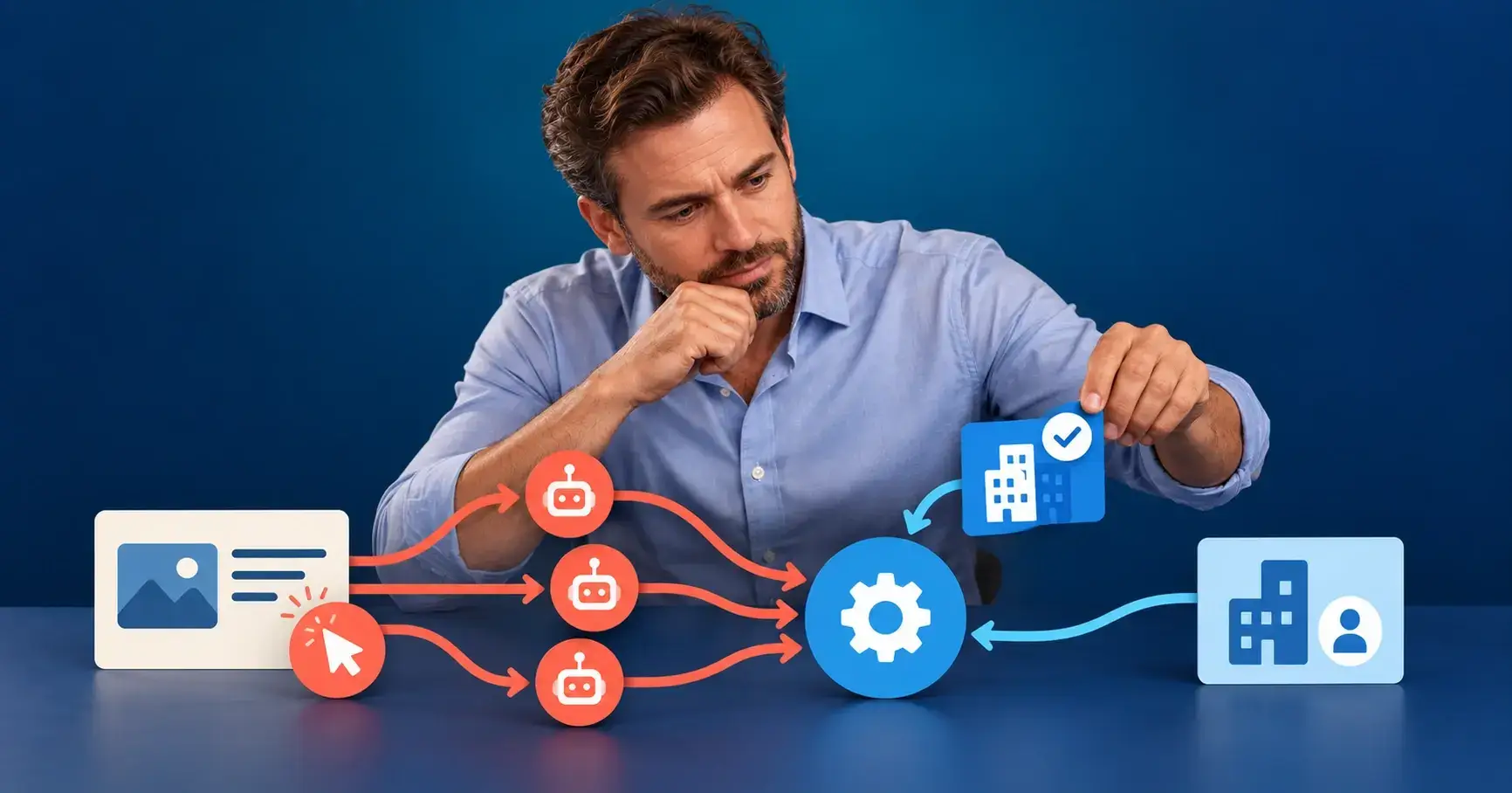
More and more browsers come with a built-in AI agent. You give it a task, say “compare three suppliers of business software”, and the agent reads pages, fills in fields and clicks through. That includes ads, when they are in the way or look relevant.
Mostly this is not fraud. There is often a real user with a real question behind it. But for your campaign it is a paid click, followed by a visit that behaves differently from a buyer.
This is where the problem starts. If your account counts a page view, scroll depth or session length as a conversion, an agent can trigger that conversion. The algorithm reads it as success and goes looking for more traffic that looks the same.
That creates a loop. More agent traffic produces more light conversions, and those push your bids further in the same direction. Ad platforms do filter invalid traffic, but a filter by definition lags behind new behaviour. How to tell the difference on your own site is covered in AI traffic: bot or real visitor.
B2B is especially sensitive. An online shop learns from a large stream of purchases, in which a few false signals disappear. A B2B campaign often runs on a handful of conversions a week. Then every false signal carries real weight.
An agent never becomes a customer
There is one conversion an agent cannot reach. An agent does not sign a contract, does not appear as a deal in your CRM and does not become a customer.
That makes the end of your funnel the most reliable signal you have. A company you can identify, that fits your ideal customer profile and that later shows up as an opportunity in your pipeline, is by definition not an agent.
One of our agency partners describes buying intent as a question of probability rather than certainty. That is a useful lens here. A click is a weak probability. An identified company that matches your ICP is a stronger one. A deal in your CRM is as close to certainty as you will get. Feed the algorithm the strongest signal you have, not the one that is easiest to collect.
The same shift applies to your bidding strategy. The question is no longer how many conversions a campaign produces, but which companies. If you already put lead quality ahead of volume, you have the foundation for this approach in place.
Send real conversions back to your ad platform
The answer is offline conversions. You send a conversion that happens later, outside the ad platform, back to that platform, linked to the original click. Offline conversions teach Google Ads which companies convert. That shifts the goal from more conversions to better companies.
In practice it comes down to three choices:
- Pick a conversion an agent cannot reach. For example an identified company within your ICP, a qualified opportunity or a closed deal.
- Keep the link between click and company. In Google Ads that is the click ID attached to every ad click. Without it, the platform cannot tell which click your conversion belongs to.
- Send it back and bid on that goal. Let the platform optimise on the offline conversion rather than on the form or the page view.
Our partner We Message already works this way. They send offline conversions back to Google Ads based on the click ID, so marketing can justify its spend with commercial data instead of clicks.
A performance agency in our network starts even earlier. A trigger fires as soon as a company from the ICP visits specific pages and comes back. Through Zapier, that visit is recorded as an offline conversion in Google Ads. The agency has run this setup for years, with better leads as the result.
This is where Leadinfo comes in. Leadinfo shows which companies arrive on your website through Google Ads and what they do there. With triggers you decide when such a visit counts, and through the Google Ads + Leadinfo integration that signal flows back into your campaigns.
Because Leadinfo identifies companies rather than individuals, the signal you send back sits at company level. If you only want the conversion to count once there is an opportunity in your CRM, first read how to connect identified website visitors to your CRM.
The same principle applies to Advantage+. Meta also learns from the conversions you supply. Use the route Meta itself offers for sending conversions from your server or CRM, and pick a goal there that only a real company can reach.
Getting started
Your campaigns show better numbers than your pipeline, and that gap is exactly what the algorithm is learning from. Start tomorrow with a quick check: open your conversion settings and, next to every conversion action, ask whether an agent could trigger it. If the answer is yes, it is not a good bidding goal. Choose a goal from your CRM and send it back as an offline conversion. Leadinfo makes that step smaller, because identified ICP companies go straight back to Google Ads through a trigger. Once it runs, look back each month at which companies came in through which campaign, and whether the algorithm is moving towards them.
Frequently asked questions
Can AI agents click on my Google Ads?
Yes. Browsers with a built-in AI agent read pages and click links on behalf of a user, and ads can be among them. Usually that is not fraud, but it is still a click from something that will never become a customer. If your account counts such visits as conversions, Smart Bidding learns to look for more of that traffic.
What are offline conversions in Google Ads?
An offline conversion is a conversion that happens outside Google Ads, such as a qualified opportunity or a deal in your CRM. You send it back, linked to the original click. That way Google Ads learns which companies really convert, rather than which visitors fill in a form or stay on a page for a long time.
Does this also work for Meta Advantage+?
The principle is the same: Advantage+ optimises on the conversions you supply. Use the route Meta offers to pass conversions from your server or CRM, and choose a goal an agent cannot reach. Leadinfo has a direct integration with Google Ads and LinkedIn Ads, not with Meta.
